
LASIK, PRK or SMILE: Which Laser Eye Surgery Is Right for You?
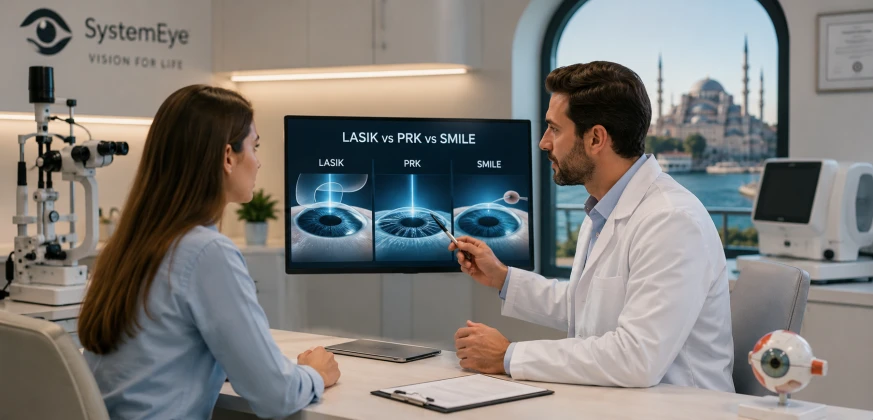
LASIK, PRK or SMILE: Which Laser Eye Surgery Is Right for You?
Laser eye surgery can reduce dependence on glasses or contact lenses by reshaping the cornea so that light focuses more accurately on the retina. Among the most frequently considered procedures are LASIK, PRK and SMILE.
Although all three methods aim to improve refractive errors, they are not interchangeable. Corneal thickness, prescription level, dry-eye tendency, lifestyle, occupation and individual eye anatomy can all influence which procedure may be more appropriate.
The most suitable treatment can only be determined after a detailed eye examination. This guide explains the main differences between LASIK, PRK and SMILE to help patients understand the available options before consulting an ophthalmologist.
What Is LASIK Eye Surgery?
LASIK is one of the most widely performed laser vision correction procedures. During LASIK, the surgeon creates a thin flap on the cornea. The flap is lifted, and an excimer laser reshapes the underlying corneal tissue. The flap is then repositioned.
LASIK may be used to correct myopia, hyperopia and astigmatism in suitable patients. The American Academy of Ophthalmology describes LASIK as a procedure that reshapes the cornea to improve how light is focused inside the eye.
Main advantages of LASIK
LASIK is commonly preferred because visual recovery is generally fast. Many patients notice a meaningful improvement within the first day, although vision may continue to stabilise over the following days or weeks.
Other possible advantages include:
- Relatively fast visual recovery
- Less discomfort during the early recovery period compared with PRK
- Treatment of myopia, hyperopia and astigmatism
- Long clinical history and wide availability
- Possibility of customised wavefront- or topography-guided treatment in selected patients
Research comparing LASIK and PRK has found that LASIK generally provides faster early visual recovery, while the overall effectiveness of the two procedures can be comparable.
Who may be suitable for LASIK?
LASIK may be considered for adults who have:
- A stable glasses or contact-lens prescription
- Adequate corneal thickness
- Healthy corneal topography
- No uncontrolled eye disease
- Realistic expectations about the result
- No significant untreated dry-eye condition
LASIK may not be recommended when the cornea is too thin or irregular, when keratoconus is suspected, or when certain medical or eye conditions increase surgical risk. The FDA advises patients to undergo a detailed suitability assessment and understand the limitations and risks before surgery.
What Is PRK Eye Surgery?
PRK, or photorefractive keratectomy, is a surface laser treatment. Unlike LASIK, no corneal flap is created.
During PRK, the thin outer layer of the cornea, called the epithelium, is removed. An excimer laser then reshapes the corneal surface. A protective contact lens is usually placed over the eye while the epithelium heals.
Main advantages of PRK
PRK may be considered when creating a corneal flap is not desirable. It can be useful for some patients with relatively thin corneas, certain occupational needs or lifestyles involving a greater risk of eye trauma.
Possible advantages include:
- No corneal flap
- Potential suitability for selected patients with thinner corneas
- No flap-related complications
- Established long-term clinical use
- Suitable for some active occupations and contact-sport lifestyles
PRK and LASIK can achieve comparable refractive outcomes in suitable patients, but PRK usually has a slower and less comfortable early recovery period.
What is PRK recovery like?
PRK recovery is usually slower than LASIK or SMILE. Patients may experience watering, light sensitivity, blurred vision, burning or discomfort during the first few days.
The surface layer of the cornea generally needs several days to heal. Functional vision often improves gradually, while full visual stabilisation may take several weeks or longer.
Because of this slower recovery, PRK patients should plan more time before returning to driving, screen-intensive work or demanding daily activities.
What Is SMILE Eye Surgery?
SMILE stands for Small Incision Lenticule Extraction. It is a flap-free laser procedure mainly used to correct myopia and astigmatism.
During SMILE, a femtosecond laser creates a small disc-shaped piece of tissue, called a lenticule, inside the cornea. The surgeon removes this tissue through a small incision, changing the shape of the cornea.
The American Academy of Ophthalmology identifies SMILE as a newer refractive procedure used for nearsightedness and astigmatism.
Main advantages of SMILE
Possible benefits of SMILE include:
- No large corneal flap
- Small incision
- Fast return to many daily activities
- Less disruption of some corneal nerves
- Potentially lower impact on dry-eye symptoms in selected patients
- Suitability for some active lifestyles
Several studies have found broadly comparable visual outcomes between SMILE and femtosecond LASIK for myopia and myopic astigmatism. Some research suggests that SMILE may have a smaller effect on the ocular surface and corneal nerves, although individual results vary.
Limitations of SMILE
SMILE is not automatically the best choice for every patient. Depending on the technology, regulatory approval and individual prescription, it may be more limited than LASIK in treating hyperopia or certain complex refractive errors.
Enhancement procedures after SMILE may also require a different surgical approach rather than simply repeating the original treatment.
Which Procedure Is Better for Thin Corneas?
Patients with thin corneas are often told that PRK may be considered because it does not require the creation of a LASIK flap. However, corneal thickness alone is not enough to select a procedure.
The surgeon must also evaluate:
- Corneal shape
- Corneal strength
- Residual stromal thickness
- Prescription level
- Pupil size
- Topography and tomography results
- Risk of corneal ectasia
A thin or irregular cornea may make all corneal laser procedures unsuitable. In such cases, another treatment, such as an implantable contact lens, may be considered.
Which Procedure Has the Fastest Recovery?
LASIK generally offers the fastest early visual recovery. Many suitable patients can return to desk-based work within a short period, depending on their vision and the surgeon’s advice.
SMILE also provides a relatively fast recovery, although some patients may notice slightly slower visual sharpness during the first days compared with LASIK.
PRK usually requires the longest recovery. The first few days can be uncomfortable, and clear vision may develop more gradually.
Fast recovery should not be the only reason for choosing a procedure. Long-term corneal safety and individual suitability are more important than returning to work one or two days earlier.
Which Procedure Is Better for Dry Eyes?
Any corneal laser surgery can temporarily affect tear production and cause dry-eye symptoms.
Because LASIK involves creating a flap and cutting more corneal nerve fibres, dry-eye symptoms may be more noticeable in some patients after surgery. SMILE uses a smaller incision and may preserve more corneal nerves, which could reduce the impact on tear-film stability in selected patients. PRK avoids a flap but still affects the corneal surface during healing.
A meta-analysis reported a significant postoperative reduction in some tear-film measurements after LASIK, while changes after SMILE and PRK were less pronounced in the available studies. The authors also noted that more high-quality research was needed.
Patients with existing dry eye should have the condition assessed and treated before undergoing laser eye surgery.
Which Procedure Is Best for Athletes?
For people involved in contact sports, combat sports or occupations with a risk of eye impact, flap-free treatments may be considered.
PRK and SMILE do not leave a LASIK-style flap. This can be relevant for athletes, military personnel or people working in physically demanding environments.
However, the final decision should still be based on corneal structure, prescription and the type of sport or occupation.
Are LASIK, PRK and SMILE Safe?
All surgical procedures involve possible risks. Laser eye surgery can cause temporary or, less commonly, persistent side effects.
Possible effects include:
- Dry-eye symptoms
- Glare or halos
- Night-vision difficulties
- Light sensitivity
- Undercorrection or overcorrection
- Fluctuating vision
- Infection or inflammation
- Need for enhancement treatment
- Continued need for glasses
- Rare loss of visual quality
The FDA notes that some LASIK patients can experience glare, halos, double vision, reduced low-contrast vision or the need for further correction.
A responsible clinic should explain both the expected benefits and possible limitations. No surgeon should guarantee perfect vision or promise that glasses will never be needed again.
How Is the Right Laser Treatment Chosen?
A comprehensive preoperative examination may include:
- Visual acuity testing
- Refraction measurement
- Corneal thickness measurement
- Corneal topography and tomography
- Tear-film evaluation
- Pupil-size measurement
- Retinal examination
- Eye-pressure measurement
- Review of previous prescriptions
- Assessment of medical history and medication use
The surgeon then evaluates whether LASIK, PRK, SMILE or another treatment is the safest and most appropriate option.
LASIK, PRK or SMILE: Which One Should You Choose?
There is no single procedure that is best for everyone.
LASIK may be attractive for patients who want rapid visual recovery and have suitable corneal measurements.
PRK may be considered for selected patients with thinner corneas, active lifestyles or situations where a corneal flap is not preferred.
SMILE may be suitable for patients with myopia or astigmatism who want a small-incision, flap-free procedure and meet the required anatomical criteria.
The safest decision is made after a complete eye examination rather than through an online comparison alone.
Frequently Asked Questions
Is SMILE better than LASIK?
Neither method is universally better. SMILE may offer advantages related to the small incision and possibly lower dry-eye impact, while LASIK may offer faster early visual recovery and broader customisation options in selected cases.
Is PRK safer than LASIK?
PRK avoids flap-related risks, but it has a slower recovery and different possible complications. Safety depends on the patient’s corneal structure and overall suitability.
Can LASIK, PRK or SMILE correct astigmatism?
All three procedures may correct astigmatism within suitable treatment ranges. The amount and type of astigmatism can influence which method is recommended.
Can both eyes be treated on the same day?
In many cases, both eyes can be treated during the same session. The final decision depends on the surgeon’s assessment and clinic protocol.
Will I need glasses again after laser eye surgery?
Laser surgery can reduce dependence on glasses, but it cannot guarantee that glasses will never be needed. Age-related reading difficulty, prescription changes or residual refractive error may still require correction.
How long should international patients stay in Istanbul?
The recommended stay depends on the procedure, early follow-up schedule and the surgeon’s advice. Patients should not book their return flight until the clinic confirms that the initial postoperative examination has been completed.
Medical Disclaimer
This content is for general information and does not replace an eye examination, diagnosis or individual medical advice. The appropriate treatment can only be determined by an ophthalmologist after detailed testing.